Circumventing Wastewater Regulations with Sustainable Engineering Solutions!

Before we get started, a short teaser……

Our Australian federal government is one of the biggest pains in our collective backsides’, taking our hard earned money and seemingly wasting it. It seems that the government exists simply to make our lives more difficult…..

Image may contain: 1 person, smiling
(What a time to be alive….)

However, governments do provide several key services for our everyday life…. including wastewater infrastructure and management, and their upgrade and maintenance.

Regulatory framework and wastewater engineering

Firstly, what is regulatory framework? Well its defined as any laws, regulations, decrees and policies officially developed and approved by the government (Law Insider). Regulatory framework is one of the key responsibilities of the government, or well at least of a good government.

If we focus on wastewater (as I have done in my most recent blogs), just by looking up some legislation about wastewater in WA, you can see just how much there is.

(This isn’t even all of it)

Just by looking at this list you can see that the government has regulations (“guidelines”) telling us how to manage onsite wastewater systems, water holding tanks (i.e. rainwater tanks) as well as the important, obligatory health and safety guidelines.

So, is there a relationship between regulatory frameworks and wastewater engineering? Well, yes. Afterall, the government governs everything we do.

BUT, are these frameworks able to provide a solution to wastewater problems in remote areas? I’m not sure. So, heres a radical idea, lets think about some sustainable technology and development ideals from the UN, and engineering principles.

Are regulatory frameworks REALLY that important?

As usual, when it comes to ensuring the continual development of countries, the United Nations has some ideas in the form of their sustainable development goals (SDGs).

(Thanks UN)

The UN outlines the importance of sanitation, and has goals, particularly in regards to developing more sustainable and long-lasting infrastructure (including wastewater) in developing nations. I think this is important too.

Water supply and wastewater management infrastructure in urban and rural areas comprises 4 major systems (Ashley & Cashman 2006):

  1. Water abstracted for agricultural use (i.e. for irrigation and livestock).
  2. Water resources (i.e. for human needs, mostly drinking and hygiene).
  3. Water supply network (i.e. pipes and pumps etc).
  4. Wastewater infrastructure (i.e. stormwater/sanitary drainage, treatment, effluent disposal and residual sludge management).

As Ashley & Cashman (2006) discuss, standards are important in assessing the demand for and state of wastewater-related infrastructure… and of course these vary worldwide. There are ever increasing standards in developed nations, but only ever bare minimum standards in under-developed or developing nations.

Now of course there can’t be a worldwide standard because every area of human habitation is different – some live in urban areas, and others rural.

Its impossible to provide a one-size-fits-all solution…. right?

Centralised vs. Decentralised

I think one problem with our traditional, centralised wastewater infrastructure is that it IS CENTRALISED. Whilst its great for serving a large number of people in an urban area, its not effective for rural/remote areas.

More than likely, rural areas will require DECENTRALISED wastewater management infrastructure.

Often its more cost-effective for the government (i.e. you, the tax-payer) and realistic for rural areas to have their own wastewater infrastructure (potable water source, piping/pumps etc and wastewater treatment facilities) (Capodaglio 2017). Also, its simple to construct a decentralised system for the local climatic, aesthetic and water quality requirements (i.e. more socially acceptable) (Sharma et al. 2012).

Lets think about a low population (>100 people) rural, agricultural community. Irrigation would be the biggest water requirement resulting in nutrient-contaminated runoff (from fertilizer), so wastewater treatment is vitally important for environment of the local area.

So whats a solution for this rural area?

‘Centralising’ a decentralised solution

Now as I have alluded to, there are a littany of different regulatory frameworks not just internationally, but also interstate in Australia. So I thought instead, lets think about an engineering perspective.

The UN’s SDG 9 focuses on sustainability, so in essence it is the same as an engineering solution, and these involve the Triple Bottom Line (TBL), which can be applied to almost any solution (i.e. ‘centralised’).
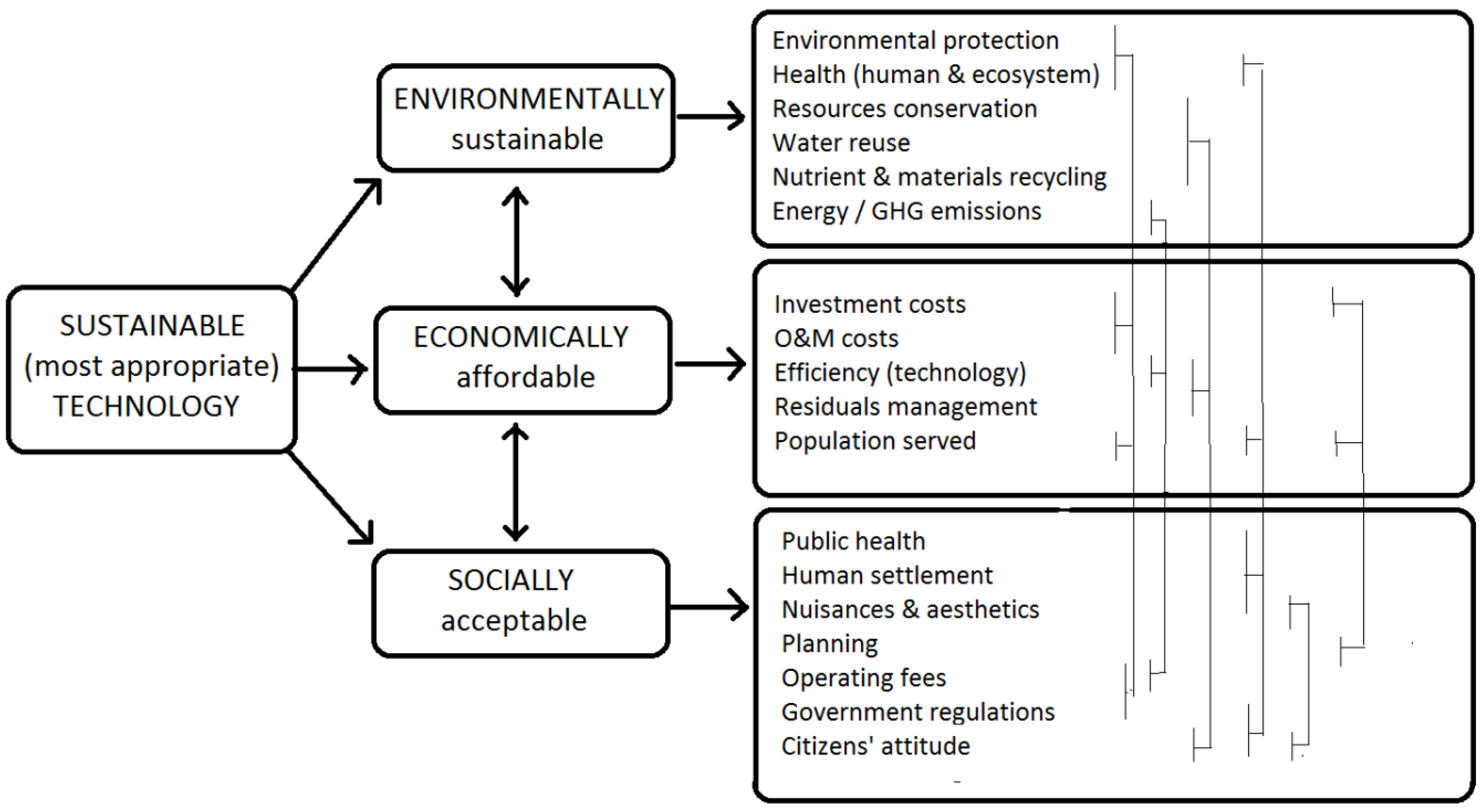
Resources 06 00022 g001
(Sustainable technology thoughts tree)

Rural infrastructure needs to be future-proof, hence it has to environmentally sustainable, economically affordable and socially acceptable. Ergo, I have the perfect smart solution to wastewater concerns of our (fictional) rural community:
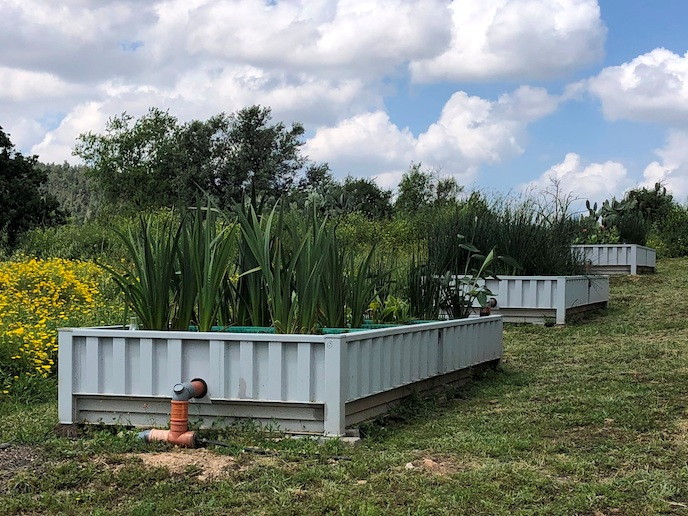
(VOILA)

A PORTABLE WASTEWATER TREATMENT SYSTEM!!!!

Well to be more specific, what you see above is a Portable Modular Natural Biological System (M-NBS). Here is a simple explanation for how it works: it goes in untreated, comes out treated.

(A more in-depth explanation)

As outlined by its developer, Ayala Water and Ecology, the development of this system aimed to fill a technological gap in small, rural areas where potable water sources are scarce and sewage issues are rife, where conventional decentralised systems were failing. Conventational systems fail due to compartively large operation costs and a lack of reliable electricity and skilled operations teams.

Perusing the M-NBS benefits (see here), lets see if they check all of our TBL requirements for our fictional little rural town:

  • Environmentally sustainable?
  • ECONOMICALLY affordable?
  • SOCIALLY acceptable?

FANTASTIC!

Time for implementation…..?

Unfortunately, we can’t begin put these solutions into practice just yet.

Rather ironically, there are a lot of government regulation hurdles for any new technology, particularly one that utilises natural processes, to overcome before it can be implemented (Schellenberg et al. 2020). First-world governments worldwide are already invested in large, established, centralised infrastructure networks, so introducing decetralised solutions will always be difficult.

However, this in a way presents an opportunity. If such solutions as the suggested M-NBS are a success, this will fling open the door for new/updated regulatory framework to allow for these ecological, decentralised solutions to be implemented.

Both basic engineering principles, and the UN’s SDGs point to a cost-effective, sustainable, decentralised solution i.e. the M-NBS, which can be tailored for anywhere and implemented anywhere, including rural or urban areas in developed or developing countries.

This is the future, but we need it soon.

Over to you governments…….
Powering our Wastewater Future: Wastewater-to-Energy

Before we get started heres a little teaser….

Electricity is (virtually) as important to people in first-world now as water and food. Whilst it powers our lights, TV’s and phone chargers, it is also vitally important in powering our largely forgotten Wastewater Infrastructure.

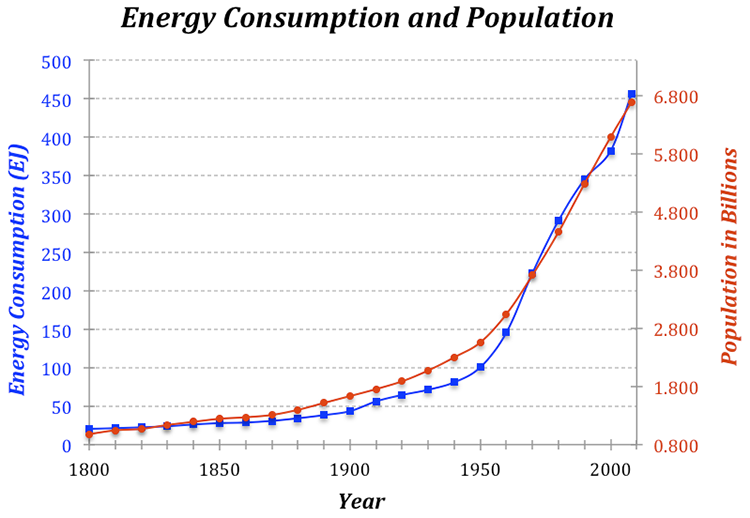
Wastewater in my opinion is our most important infrastructure resource that is taken for granted. However, you will find that municipal wastewater treatment facilities are among our greatest electricity consumers – averaging approximately 1%-3% of a country’s total electricity output (Capodaglio & Olsson 2019). And with populations ever increasing, we will need ever more electricity to power our wastewater infrastructure.

history of global energy consumption vs population. The two curves follow a very similar path,
(Population growth is the key factor in increased energy consumption)

Question: Whats the answer to our electricity problem?

Climate change is arguably the biggest problem facing our current world. Its important to leave our world in good shape for our children and theirs. We need to live more sustainably.

Traditional renewables, by which I mean solar and wind power, whilst popular, cannot be relied upon to power our vital wastewater infrastructure! This is primarily due to the fact that the sun and wind are intermittent – solar panels and wind turbines cannot be generating power all the time, only when its sunny or windy respectively.

solar system output in kWh
(Example: The seasonality of solar panel electricity generation)

There are certain benefits to having solar/wind power sources to compliment existing sources, and I do believe that every house in Australia (depending on climate of course) should have solar panels to take advantage of our natural, renewable resources as much as possible. However, we need another, reliable, yet sustainable, general source of electricity.

This discussion gives me an idea: what if we could use our wastewater to power our wastewater infrastructure? Much like we can use our houses and their solar panels to power our household electricity?

Using Wastewater…. to Power our Wastewater Infrastructure…..???

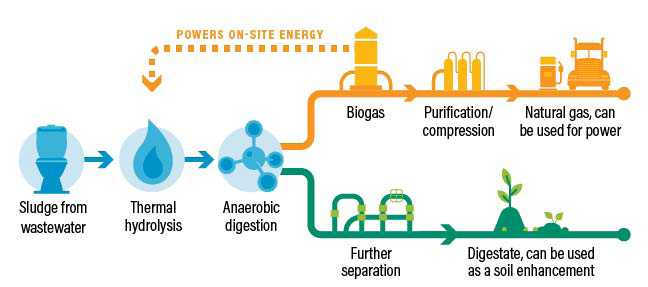
Wastewater, and its byproducts contain sources of energy in several forms i.e. chemical, thermal and potential (Capodaglio & Olsson 2019). Wastewater sludge is one of those byproducts. Anerobic digestion (a natural process) converts the organics present in the wastewater into biogas, which in turn can be used to generate electricity (Australia Water Association 2020).

(Wastewater sludge can be used for on-site power and to enhance soil)

Another benefit of this solution is that it doesn’t have to be centralised. Anaerobic treatment with biogas production for electricity is an effective, realistically implementable local solution for industrial sites and farms too! This allows for effective management of wastewater, and a sustainable production of electricity which can reduce operating costs (Sustainability Matters 2019). I think this is a BRILLIANT solution.

Many wastewater treatment plants (WWTPs) around the world have already turned to aerobic digestion to produce biogas for electricity production! For instance, the Glenelg Wastewater Treatment Plant in South Australia already has 74% of its electricity needs produced by its own, wastewater sludge generated biogas (Australian Water Associated 2020).

The economic viability of this method of energy production is fantastic! Wastewater treatment is a very expensive process, but approximately 30% of the cost is for the electricity to power it (Water Online 2018). Hence, effectively using the same process to produce its own power is not only sustainable, but also economically viable!

We need to think about the Future!

Our populations are ever increasing, and thus its important to acknowledge that our WWTPs must prepare for this increased demand. With increased wastewater ‘traffic’, and the potential of unknown-future constituents of concern, the requirement for electricity to power our wastewater infrastructure is ever increasing. Hence, we need to be prepared.

Thermal energy (biogas) production contained in wastewater is already in-use today, and whilst this should be expanded to more WWTPs, their should also be a greater focus on the utilisation of energy stored in carbon compounds (Schaum 2018). One such innovation planned is the Microbial Fuel Cell, which turns bacteria found in wastewater into electricity!

Schematic of an osmotic microbial fuel cell (OsMFC). 
(Schematic of a microbial fuel cell – its a little cut-off, but you get the idea)

It is also hoped that the fuel cell can be improved to produce electricity on an ever increasing scale.

In the future it is believed that WWTPs will expand their scope from just wastewater treatment to become system service providers, entailing wastewater treatment, production of electricity, potable water provision and the ability to manufacture fertilizer (for food production). It will envelope the most vital ingredients of our human society (Schaum 2018).

Its important to invest in this infrastructure sooner, rather than later

Given our current (and predicted future) vulnerability to climate change, we need to be proactive, not reactive, when it comes to planning for our future infrastructure and electricity requirements.

(SDG 9: Build resilient infrastructure, promote sustainable industrialization and foster innovation)

The UN’s Sustainability Goal 9: Industry, innovation and infrastructure discusses the importance to plan for a sustainable future, by acknowledging the increase demands that comes with increased population, by finding a technogical solution that is sustainable, both environmentally and economically.

Enter wastewater energy production! It fits all the criteria. Using wastewater to produce electricity takes advantage of an almost endless supply of potential electricity (people will always produce), and has been found to be very cost-effective! There are existing solutions that also allow for the more sustinable, local production of electricity from wastewater (anaerobic digestion). This is also in-line with UN’s sustainable development goal of building resilient infrastructure and promoting sustainable industrialisation.

We need more efficient, cheaper and effective innovative ways to produce electricity to power our ever increasing requirement for wastewater treatment and infrastructure. And if we’re fortunate and creative, wastewater can also provide the foundation which provides our future generations, not only with wastewater services, but also electricity, clean water and the ability to aid food production.

The innovation and technology is already (or almost) here. We just need to implement it.